Teratoma Sacrococcígeo em Adulto: Relato de Caso e Revisão Sistemática da Literatura
Barra lateral de artigos
Conteúdo do artigo principal
Resumo
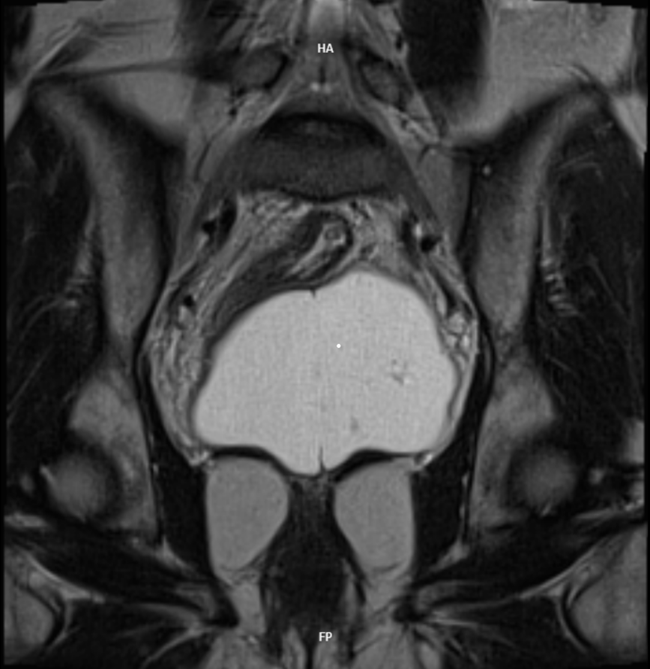
Os teratomas sacrococcígeos são tumores germinativos derivados de células pluripotentes, raramente diagnosticados em adultos, correspondendo a menos de 10% dos casos descritos. As manifestações clínicas são geralmente inespecíficas, sendo os exames de imagem fundamentais para o diagnóstico e o planejamento terapêutico. Relata-se o caso de uma paciente de 30 anos com dor pélvica crônica e desconforto sacrococcígeo. A ressonância magnética de pelve demonstrou volumosa lesão sólida-cística, multilobulada e septada, com predomínio adiposo, localizada no espaço pré-sacrococcígeo, medindo 8,3 × 10,1 × 9,6 cm, sem invasão óssea ou acometimento ginecológico. A principal hipótese diagnóstica foi teratoma sacrococcígeo maduro, com indicação de ressecção cirúrgica eletiva. Foi realizada revisão sistemática da literatura conforme PRISMA 2020 e metodologia Cochrane, incluindo 15 estudos com 28 pacientes adultos. Houve predomínio do sexo feminino (82,1%), com idade entre 19 e 56 anos. Dor pélvica ou sacrococcígea foi o sintoma mais frequente (67,8%), e a ressonância magnética foi utilizada em todos os casos. Todos os pacientes foram submetidos à ressecção cirúrgica, com coccectomia em 64,2%, sem complicações graves ou recorrência nos casos acompanhados após coccectomia. Os teratomas sacrococcígeos em adultos são entidades raras que requerem alto grau de suspeição clínica e investigação por imagem. O caso reforça o papel da ressonância magnética no diagnóstico diferencial de massas pélvicas e sustenta a ressecção completa, associada ou não à coccectomia, como tratamento de escolha. A ausência de coccectomia esteve associada a maior risco de recidiva em seguimento prolongado, embora não de forma universal.
Detalhes do artigo

Este trabalho está licenciado sob uma licença Creative Commons Attribution 4.0 International License.
Authors retain the copyright of their articles and grant the journal the right of first publication under the Creative Commons Attribution (CC BY) license, which allows others to share and adapt the work with proper attribution.
Referências
Altman RP, Randolph JG, Lilly JR. Sacrococcygeal teratoma: American Academy of Pediatrics Surgical Section survey–1973. J Pediatr Surg. 1974;9(3):389-98.
Keslar PJ, Buck JL, Suarez ES. Germ cell tumors of the sacrococcygeal region: radiologic-pathologic correlation. Radiographics. 1994;14(3):607-20.
Arikan S, Yildiz MK, Tekin A, Ekici M, Sayan A. Sacrococcygeal teratoma in an adult: a case report. J Surg Case Rep. 2015;2015(6):rjv064.
Murat F, et al. Adult sacrococcygeal teratomas: surgical strategy and oncological outcomes in a French multicenter cohort. Ann Surg Oncol. 2025;32(1):122-9.
Keating JP, et al. Presacral tumors: a review of clinical presentation, diagnosis, and management. Colorectal Dis.2020;22(1):23-31.
Szyllo K, Lesniewska M. Sacrococcygeal teratoma in adults: diagnostic and therapeutic challenge. Ginekol Pol.2015;86(2):146-9.
Li Y, Zhang S, Sun J, Niu H. MRI features of adult presacral teratomas: correlation with surgical findings. Eur J Radiol. 2017;95:20-6.
Niu H, Zhang S, Sun J, Li Y. Adult sacrococcygeal teratoma: clinical features and treatment outcomes. BMC Surg.2021;21(1):135.
Murat FJ, et al. Management of presacral teratomas in adults: long-term outcomes of a multicenter series. Colorectal Dis. 2019;21(12):1435-42.
Higgins JPT, Thomas J, Chandler J, Cumpston M, Li T, Page MJ, Welch VA, eds. Cochrane Handbook for Systematic Reviews of Interventions. 2nd ed. Chichester (UK): John Wiley & Sons; 2019.
Page MJ, McKenzie JE, Bossuyt PM, Boutron I, Hoffmann TC, Mulrow CD, et al. The PRISMA 2020 statement: an updated guideline for reporting systematic reviews. BMJ. 2021;372:n71.
Khalil J, et al. Adult sacrococcygeal teratoma: report of a case. Egypt J Surg. 1999;18(2):145-8.
Yalcin S, Cakmak O, Kutluay L, Ozyilmaz F. Adult sacrococcygeal teratoma: report of a case. Acta Chir Belg.2005;105(1):105-7.
Ozdemir O, Tanyel FC, Buyukpamukcu N. Adult sacrococcygeal teratoma: report of a case and review of the literature. Turk J Cancer. 2011;41(1):32-5.
Moslemi MK, et al. Adult sacrococcygeal teratoma: case report and literature review. Case Rep Oncol.2012;5(2):490-5.
Eke N, et al. Presacral teratoma in an adult Nigerian: case report and review. West Afr J Med. 2014;33(2):146-9.
Chen W, Yang Y, Zhang H, et al. Adult presacral teratoma: a report of two cases and review of the literature. Oncol Lett. 2016;12(1):73-6.
Sharma A, Goyal A, Gupta S, Kumar V. Sacrococcygeal teratoma in adult female: a case report. Cureus.2021;13(9):e18255.
Patel K, Smith L, Khan M. Presacral mature teratoma in adult women: case report and literature review. BMJ Case Rep. 2022;15(4):e247650.
Ahmed R, Qureshi S, Khan A. Adult sacrococcygeal teratoma mimicking ovarian mass: a case report. J Pak Med Assoc. 2023;73(8):1643-6.
Santos L, Oliveira A, Barros P. Sacrococcygeal teratoma in adults: diagnostic pitfalls in pelvic masses. Rev Col Bras Cir. 2024;51(2):e20245011.
Li Z, et al. Sacrococcygeal teratoma in adults: diagnostic imaging and surgical management. World J Surg Oncol.2024;22(1):105.
Arikan H, Demirbas S, Ergun O. Adult presacral teratoma: a rare entity with review of literature. Turk J Surg.2024;40(3):254-8.
Moola S, Munn Z, Tufanaru C, Aromataris E, Sears K, Sfetcu R, et al. Chapter 7: Systematic reviews of etiology and risk. In: Aromataris E, Munn Z (eds). JBI Manual for Evidence Synthesis. JBI; 2020.