Tratamento com Radioiodo e o Desenvolvimento de Mixedema Pretibial: Uma Série de Três Casos
Barra lateral de artigos
Conteúdo do artigo principal
Resumo
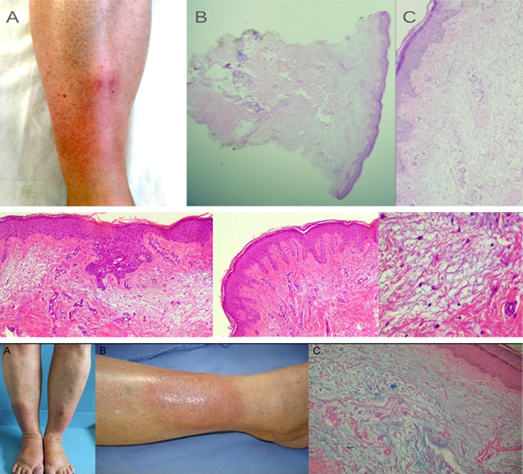
A doença de Graves apresenta-se clinicamente com sinais de hipertireoidismo e manifestações autoimunes, como a dermopatia de Graves, principalmente o mixedema pretibial. O tratamento para a doença de Graves baseia-se no uso de medicamentos antitireoidianos e na terapia com radioiodo (RAI); neste caso, a destruição das células tireoidianas e a subsequente liberação de antígenos agravam a resposta autoimune, levando ao depósito mediado por TRAb de mucina e glicosaminoglicanos na região pretibial. Este relato apresenta 3 casos de mixedema pretibial após tratamento com radioiodo para doença de Graves, acompanhado de uma breve revisão da literatura. Este artigo sugere que a dermopatia de Graves pode ocorrer devido a uma exacerbação da autoimunidade tireoidiana após a terapia com RAI. A conscientização de médicos e pacientes acerca de queixas ou alterações cutâneas desempenha um papel fundamental no diagnóstico e tratamento precoces.
Detalhes do artigo

Este trabalho está licenciado sob uma licença Creative Commons Attribution 4.0 International License.
Authors retain the copyright of their articles and grant the journal the right of first publication under the Creative Commons Attribution (CC BY) license, which allows others to share and adapt the work with proper attribution.
Referências
Davies TF, Andersen S, Latif R, Nagayama Y, Barbesino G, Brito M, et al. Graves’ disease. Nat Rev Dis Primers. 2020 Jul 2;6(1):52.
Fatourechi V. Pretibial myxedema: pathophysiology and treatment options. Am J Clin Dermatol. 2005;6(5):295–309.
Sendhil Kumaran M, Dutta P, Sakia U, Dogra S. Long-term follow-up and epidemiological trends in patients with pretibial myxedema: an 11-year study from a tertiary care center in northern India. Int J Dermatol. 2015 Aug;54(8):e280–6.
Peacey SR, Flemming L, Messenger A, Weetman AP. Is Graves’ dermopathy a generalized disorder? Thyroid. 1996 Feb;6(1):41–5.
Bull RH, Coburn PR, Mortimer PS. Pretibial myxoedema: a manifestation of lymphoedema? Lancet. 1993;341:403–4.
Bonnema SJ, Hegedüs L. Radioiodine therapy in benign thyroid diseases: effects, side effects, and factors affecting therapeutic outcome. Endocr Rev. 2012 Dec;33(6):920–80.
Laurberg P, Wallin G, Tallstedt L, Abraham-Nordling M, Lundell G, Tørring O. TSH-receptor autoimmunity in Graves’ disease after therapy with anti-thyroid drugs, surgery, or radioiodine: a 5-year prospective randomized study. Eur J Endocrinol. 2008 Jan;158(1):69–75.
Bahn RS. Graves’ ophthalmopathy. N Engl J Med. 2010 Feb 25;362(8):726–38.
Kriss JP. Pathogenesis and treatment of pretibial myxedema. Endocrinol Metab Clin North Am. 1987;16(2):409-415.
Update on pathophysiology and treatment of pretibial myxedema: A comprehensive review of the literature Katsiaunis, Apostolos et al. JAAD Reviews, Volume 4, 116 - 122
Walsh HL, Shoji MK, Gallo RA, et al. Upregulation of insulin-like growth factor-1 receptor expression in pretibial myxedema: evidence for a treatment target. Am J Dermatopathol. 2024; 46(3):153-154. https://doi.org/10.1097/DAD.0000000000002597
Lan C, Hu L, Liao C, Shi Y, Wang Y, Cheng S, Huang W. Thyroid-Stimulating Hormone Receptor Autoimmunity and Local Factors in Multiple Risk Factors Are Mainly Involved in the Occurrence of Pretibial Myxedema. J Clin Med Res. 2020 Nov;12(11):711-723. doi: 10.14740/jocmr4352. Epub 2020 Nov 3. PMID: 33224373; PMCID: PMC7665869.