Structured Perceptions During Prolonged Sedation in a Patient with Advanced HIV and Severe COVID-19: A Case Report and Analysis of Possible Clinical-Phenomenological Correlations
Article Sidebar
Main Article Content
Abstract
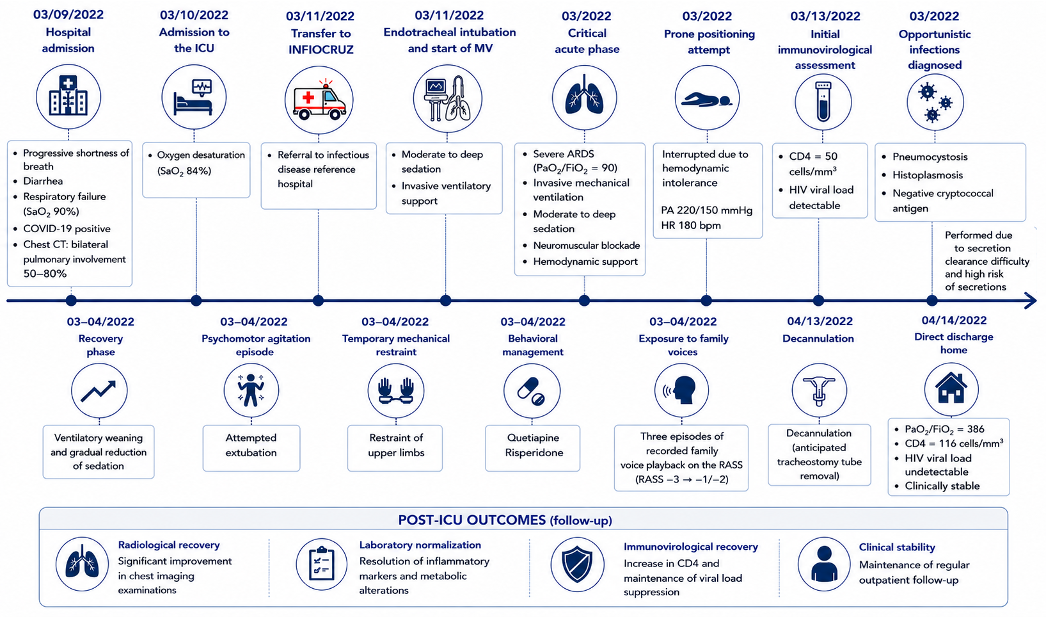
Subjective experiences occurring during prolonged sedation in critically ill patients remain poorly understood and are often attributed to delirium and retrospective memory reconstruction. We report the case of a 53-year-old male healthcare professional and university lecturer with advanced HIV infection, severe COVID-19, pneumocystosis, and pulmonary histoplasmosis, who developed severe acute respiratory distress syndrome requiring invasive mechanical ventilation, moderate-to-deep sedation, neuromuscular blockade, and tracheostomy. Following clinical recovery and gradual withdrawal of sedation, the patient described structured perceptual experiences involving sensations of drowning, confinement, environmental vapors, food perception, and recognition of a family member’s voice. Some of these experiences showed plausible temporal correspondence with events documented in the medical record, including ventilatory support, inhalation therapies, dietary changes, and transient episodes of altered sedation levels during family visits. The discussion considers alternative mechanisms, including delirium, hypoxia, COVID-19-associated neuroinflammation, HIV-related neurocognitive vulnerability, and potential effects of the pharmacological agents used during hospitalization. This case does not allow causal inferences or confirmation of specific perceptual processing mechanisms during sedation; however, it suggests that complex subjective experiences may occur during critical illness and deserve further investigation, particularly in the context of humanized intensive care practices.
Article Details

This work is licensed under a Creative Commons Attribution 4.0 International License.
Authors retain the copyright of their articles and grant the journal the right of first publication under the Creative Commons Attribution (CC BY) license, which allows others to share and adapt the work with proper attribution.
References
Jones C, Griffiths RD, Humphris G, Skirrow PM. Memory, delusions, and the development of acute post-traumatic stress disorder-related symptoms after intensive care. Crit Care Med. 2001;29(3):573–580. doi:10.1097/00003246-200103000-00019
Samuelson K. Unpleasant and pleasant memories of intensive care in adult mechanically ventilated patients—findings from 250 interviews. Intensive Crit Care Nurs. 2011;27(2):76–84. doi:10.1016/j.iccn.2011.01.003
Ringdal M, Plos K, Lundberg D, Bergbom I. Outcome after intensive care: memories, health-related quality of life, anxiety and depression. Anaesth Intensive Care. 2010;38(2):284–292. doi:10.1177/0310057X1003800212
Pandharipande PP, Ely EW. Sedative and analgesic medications: risk factors for delirium and sleep disturbances in the cri-tically ill. Crit Care Clin. 2006;22(2):313–327. doi:10.1016/j.ccc.2006.02.002
Wilson JE, Mart MF, Cunningham C, Shehabi Y, Girard TD, MacLullich AMJ, Slooter AJC, Ely EW. Delirium. Nat Rev Dis Primers. 2020 Nov 12;6(1):90. doi: 10.1038/s41572-020-00223-4. Erratum in: Nat Rev Dis Primers. 2020 Dec 1;6(1):94. doi: 10.1038/s41572-020-00236-z.
Girard TD, Jackson JC, Pandharipande PP, Pun BT, Thompson JL, Shintani AK, Gordon SM, Canonico AE, Dittus RS, Ber-nard GR, Ely EW. Delirium as a predictor of long-term cognitive impairment in survivors of critical illness. Crit Care Med. 2010 Jul;38(7):1513-20. doi: 10.1097/CCM.0b013e3181e47be1.
Maldonado JR. Delirium pathophysiology: an updated hypothesis. Crit Care Clin. 2008;24(4):789–856. doi:10.1016/j.ccc.2008.06.003
Samuelson KAM, Lundberg D, Fridlund B. Stressful memories and psychological distress in adult mechanically ventilated intensive care patients—a 2-month follow-up study. Acta Anaesthesiol Scand. 2007;51(6):671–678. doi:10.1111/j.1399-6576.2007.01333.x
Helms J, Kremer S, Merdji H, Clere-Jehl R, Schenck M, Kummerlen C, Collange O, Boulay C, Fafi-Kremer S, Ohana M, An-heim M, Meziani F. Neurologic Features in Severe SARS-CoV-2 Infection. N Engl J Med. 2020 Jun 4;382(23):2268-2270. doi: 10.1056/NEJMc2008597.
Heneka MT, Golenbock D, Latz E, Morgan D, Brown R. Immediate and long-term consequences of COVID-19 infections for the development of neurological disease. Alzheimers Res Ther. 2020;12:69. doi:10.1186/s13195-020-00640-3
Spudich S. HIV and neurocognitive dysfunction. Curr HIV/AIDS Rep. 2013;10(3):235–243. doi:10.1007/s11904-013-0179-1
Davidson JE, Aslakson RA, Long AC, Puntillo KA, Kross EK, Hart J, Cox CE, Wunsch H, Wickline MA, Nunnally ME, Netzer G, Kentish-Barnes N, Sprung CL, Hartog CS, Coombs M, Gerritsen RT, Hopkins RO, Franck LS, Skrobik Y, Kon AA, Scruth EA, Harvey MA, Lewis-Newby M, White DB, Swoboda SM, Cooke CR, Levy MM, Azoulay E, Curtis JR. Guidelines for Fa-mily-Centered Care in the Neonatal, Pediatric, and Adult ICU. Crit Care Med. 2017 Jan;45(1):103-128. doi: 10.1097/CCM.0000000000002169.
Rosa RG, Falavigna M, da Silva DB, Sganzerla D, Santos MMS, Kochhann R, de Moura RM, Eugênio CS, Haack TDSR, Bar-bosa MG, Robinson CC, Schneider D, de Oliveira DM, Jeffman RW, Cavalcanti AB, Machado FR, Azevedo LCP, Salluh JIF, Pellegrini JAS, Moraes RB, Foernges RB, Torelly AP, Ayres LO, Duarte PAD, Lovato WJ, Sampaio PHS, de Oliveira Júnior LC, Paranhos JLDR, Dantas ADS, de Brito PIPGG, Paulo EAP, Gallindo MAC, Pilau J, Valentim HM, Meira Teles JM, Nobre V, Birriel DC, Corrêa E Castro L, Specht AM, Medeiros GS, Tonietto TF, Mesquita EC, da Silva NB, Korte JE, Hammes LS, Giannini A, Bozza FA, Teixeira C; ICU Visits Study Group Investigators and the Brazilian Research in Intensive Care Net-work (BRICNet). Effect of Flexible Family Visitation on Delirium Among Patients in the Intensive Care Unit: The ICU Visits Randomized Clinical Trial. JAMA. 2019 Jul 16;322(3):216-228. doi: 10.1001/jama.2019.8766.
Jackson JC, Pandharipande PP, Girard TD, Brummel NE, Thompson JL, Hughes CG, Pun BT, Vasilevskis EE, Morandi A, Shintani AK, Hopkins RO, Bernard GR, Dittus RS, Ely EW; Bringing to light the Risk Factors And Incidence of Neuro-psychological dysfunction in ICU survivors (BRAIN-ICU) study investigators. Depression, post-traumatic stress disorder, and functional disability in survivors of critical illness in the BRAIN-ICU study: a longitudinal cohort study. Lancet Respir Med. 2014 May;2(5):369-79. doi: 10.1016/S2213-2600(14)70051-7.
Santuzzi CH, Scardua MJ, Reetz JB, Firme KS, Lira NO, Gonçalves WLS. Aspectos éticos e humanizados da fisioterapia na UTI: uma revisão sistemática Fisioter Mov. 2013 abr/jun;26(2):415-22. doi: 10.1590/S0103-51502013000200019
Jones C, Backman C, Capuzzo M, Flaatten H, Rylander C, Griffiths RD. Precipitants of post-traumatic stress disorder follo-wing intensive care: a hypothesis-generating study. Acta Anaesthesiol Scand. 2007;51(7):867–873. doi:10.1111/j.1399-6576.2007.01330.x
Pandharipande PP, Girard TD, Jackson JC, Morandi A, Thompson JL, Pun BT, Brummel NE, Hughes CG, Vasilevskis EE, Shintani AK, Moons KG, Geevarghese SK, Canonico A, Hopkins RO, Bernard GR, Dittus RS, Ely EW; BRAIN-ICU Study In-vestigators. Long-term cognitive impairment after critical illness. N Engl J Med. 2013 Oct 3;369(14):1306-16. doi: 10.1056/NEJMoa1301372.
Girard TD, Pandharipande PP, Ely EW. Delirium in the intensive care unit. Crit Care. 2008;12(Suppl 3):S3. doi:10.1186/cc6149
Ghoneim MM, Block RI. Learning and memory during general anesthesia: an update. Anesthesiology. 1997;87(2):387–410. doi:10.1097/00000542-199708000-00028
Lubke GH, Kerssens C, Phaf RH, Sebel PS. Dependence of explicit and implicit memory on hypnotic state in trauma patients. Anesthesiology. 1999;90(3):670–680. doi:10.1097/00000542-199903000-00012
Bekinschtein TA, Dehaene S, Rohaut B, Tadel F, Cohen L, Naccache L. Neural signature of the conscious processing of audi-tory regularities. Proc Natl Acad Sci U S A. 2009;106(5):1672–1677. doi:10.1073/pnas.0809667106
Kondziella D, Friberg CK, Frokjaer VG, Fabricius M, Møller K. Preserved consciousness in vegetative and minimally cons-cious states: systematic review. J Neurol Neurosurg Psychiatry. 2016;87(5):485–492. doi:10.1136/jnnp-2015-310958
Laureys S, Celesia GG, Cohadon F, Lavrijsen J, León-Carrión J, Sannita WG, Sazbon L, Schmutzhard E, von Wild KR, Zeman A, Dolce G; European Task Force on Disorders of Consciousness. Unresponsive wakefulness syndrome: a new name for the vegetative state or apallic syndrome. BMC Med. 2010 Nov 1;8:68. doi: 10.1186/1741-7015-8-68.