Spontaneous Pneumomediastinum with Concurrent Pneumopericardium in a Young Woman with Asthma: Clinical-Radiological Correlation and Conservative Outcome
Article Sidebar
Main Article Content
Abstract
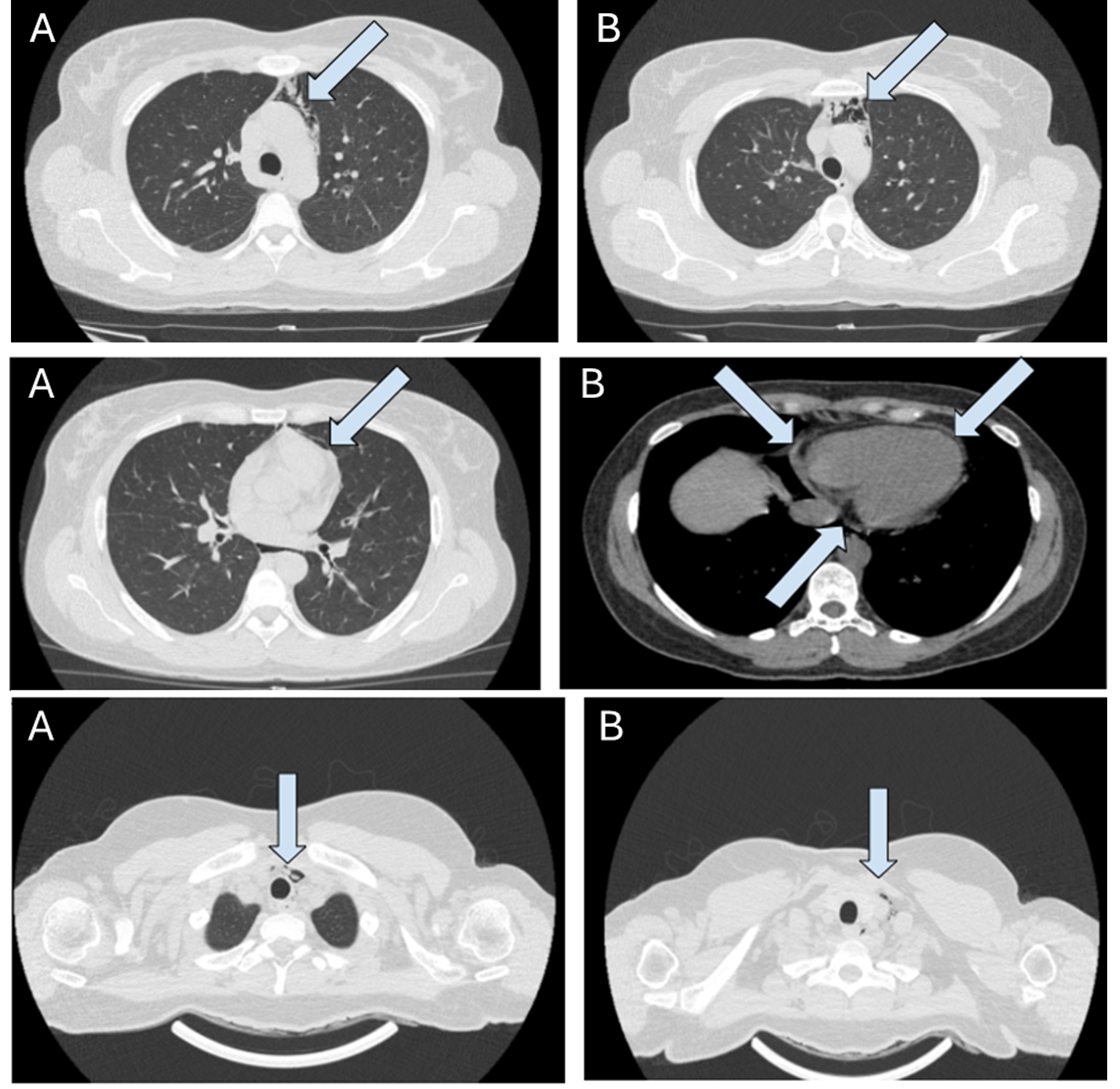
Spontaneous pneumomediastinum (SPM) is a rare and usually benign condition characterized by the presence of free air in the mediastinum without an evident traumatic or iatrogenic cause. Although classically described in young men, it may occur in women and in association with multiple precipitating factors. We report the case of a 32-year-old woman with poorly controlled asthma who presented with acute dyspnea and chest pain. Chest computed tomography confirmed extensive pneumomediastinum associated with pneumopericardium, without evidence of esophageal rupture or pneumothorax. Additional potential triggers included recent intensive weight training involving Valsalva maneuvers and the use of veterinary-origin anabolic steroids, suggesting a multifactorial mechanism of alveolar rupture. Transthoracic echocardiography excluded cardiac tamponade. The patient was managed conservatively with symptomatic support and optimization of asthma therapy, with favorable clinical and radiological evolution. This case highlights the importance of recognizing SPM and pneumopericardium in the differential diagnosis of acute chest symptoms, as well as the role of combined mechanical and inflammatory factors in its pathophysiology, reinforcing that conservative management is safe and effective in clinically stable patients.
Article Details

This work is licensed under a Creative Commons Attribution 4.0 International License.
Authors retain the copyright of their articles and grant the journal the right of first publication under the Creative Commons Attribution (CC BY) license, which allows others to share and adapt the work with proper attribution.
References
Romero JB, Hidalgo JI, Botejara EM, Vacas JA, Miranda MP. Spontaneous pneumopericardium in a patient with communi-ty-acquired pneumonia. Rev Esp Cardiol. 2005;58(2):227-9. doi:10.1157/13071898.
Winterton J, Biart S. Spontaneous pneumomediastinum and pneumopericardium in a young healthy adult with plans for air travel. Clin Case Rep. 2020;8(12):3075-3078. doi:10.1002/ccr3.3339.
Vanzo V, Bugin S, Snijders D, Bottecchia L, Storer V, Barbato A. Pneumomediastinum and pneumopericardium in an 11-year-old rugby player: a case report. J Athl Train. 2013;48(1):131-135. doi:10.4085/1062-6050-48.1.11.
Talwar A, Rajeev A, Rachapudi S, Khan S, Singh V, Talwar A. Spontaneous pneumomediastinum: a comprehensive review of diagnosis and management. Infect Disord Drug Targets. 2024;13(3):138-147. doi:10.5582/irdr.2024.01020.
Susai CJ, Banks KC, Alcasid NJ, Velotta JB. A clinical review of spontaneous pneumomediastinum. Mediastinum. 2024;8:4. doi:10.21037/med-23-25.
Semedo FHMA, Silva RS, Pereira S, Alfaiate T, Costa T, Fernandez P, Pereira A. Pneumomediastino espontâneo: relato de um caso. Rev Assoc Med Bras. 2012;58(3):355-357. doi:10.1590/S0104-42302012000300017.
Santini M, Nikše L, Mioč P, Đula K, Car S, Radeljić V, Bulj N, Zeljković I. Spontaneous pneumomediastinum and pneu-mopericardium in a young woman: a case report. Cardiologia Croatica. 2023;18(11-12):287-288. doi:10.15836/ccar2023.287.
Murayama S, Gibo S. Spontaneous pneumomediastinum and Macklin effect: overview and appearance on computed tomo-graphy. World J Radiol. 2014;6(11):850-854. doi:10.4329/wjr.v6.i11.850.
Katzir D, Klinovsky E, Kent V, Shucri A, Gilboa Y. Spontaneous pneumopericardium: case report and review of the literature. Cardiology. 1989;76(4):305-308. doi:10.1159/000174508.
Júnior LGC, Figueiredo ET, Haesbaert CM. Spontaneous pneumomediastinum (Hamman syndrome): case report. Medicina (Ribeirão Preto). 2016;49(6):574-577. doi:10.11606/issn.2176-7262.v49i6p574-577.
Ebina M, Inoue A, Takaba A, Ariyoshi K. Management of spontaneous pneumomediastinum: are hospitalization and prop-hylactic antibiotics needed? Am J Emerg Med. 2017;35(8):1150-1153. doi:10.1016/j.ajem.2017.03.017.
Dionísio P, Martins L, Moreira S, Manique A, Macedo R, Caeiro F, Boal L, Bárbara C. Spontaneous pneumomediastinum: experience in 18 patients during the last 12 years. J Bras Pneumol. 2017;43(2):101-105. doi:10.1590/s1806-37562016000000052.
Dajer-Fadel WL, Argüero-Sánchez R, Ibarra-Pérez C, Navarro-Reynoso FP. Systematic review of spontaneous pneumome-diastinum: a survey of 22 years’ data. Asian Cardiovasc Thorac Ann. 2014;22(8):997-1002. doi:10.1177/0218492313504091.
Caceres M, Ali SZ, Braud R, Weiman D, Garrett HE. Spontaneous pneumomediastinum: a comparative study and review of the literature. Ann Thorac Surg. 2008;86(3):962-966. doi:10.1016/j.athoracsur.2008.04.067.
Bakos CT, Pupovac SS, Ata A, Fantauzzi JP, Fabian T. Spontaneous pneumomediastinum: an extensive workup is not required. J Am Coll Surg. 2014;219(4):713-717. doi:10.1016/j.jamcollsurg.2014.06.001.
Agarwal MP, Giri S, Jain R, Sharma V. Spontaneous pneumopericardium in acute asthma. Int J Emerg Med. 2010;3(2):141. doi:10.1007/s12245-010-0158-z.
Meireles J, Neves S, Castro A, França M. Spontaneous pneumomediastinum revisited. Respir Med CME. 2011;4(4):181-183.
Macia I, Moya J, Ramos R, Morera R, Escobar I, Saumench J, et al. Spontaneous pneumomediastinum: 41 cases. Eur J Car-diothorac Surg. 2007;31(6):1110-1114.
Takada K, et al. Spontaneous pneumomediastinum: an algorithm for diagnosis and management. Ther Adv Respir Dis. 2009;3(6):301-307.
Sahni S, et al. Spontaneous pneumomediastinum: time for consensus. North Am J Med Sci. 2013;5(8):460-464.