Radioiodine Treatment and The Development of Pretibial Myxedema: A Series of Three Cases
Article Sidebar
Main Article Content
Abstract
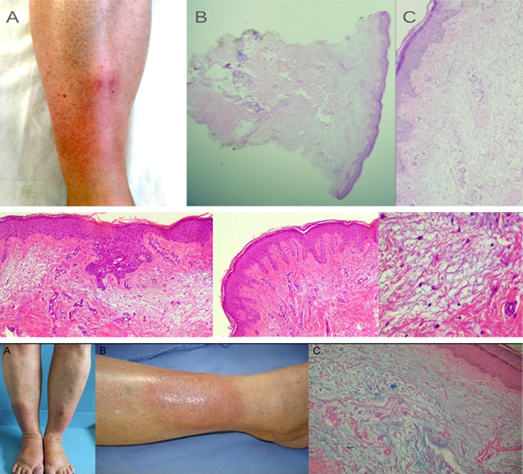
Graves’ disease presents itself clinically with signs of hyperthyroidism and autoimmune manifestations like Graves’ dermopathy, mainly the pretibial myxedema, treatment for Graves’ disease relies on the use of antithyroid medications and radioiodine treatment (RAI) in which case the thyroid cell destruction and subsequent antigen release aggravates the autoimmune response leading to TRAb mediated mucin and glycosaminoglycan deposition in the pretibial area. This report presents 3 cases of pretibial myxedema after radioiodine treatment for Graves’ Disease combined with a brief literature review. This paper suggests that Graves’ dermopathy could be due to an exacerbation of thyroid autoimmunity after RAI treatment. Physicians and patients' awareness of skin complaints or alterations play a key role in early diagnosis and treatment.
Article Details

This work is licensed under a Creative Commons Attribution 4.0 International License.
Authors retain the copyright of their articles and grant the journal the right of first publication under the Creative Commons Attribution (CC BY) license, which allows others to share and adapt the work with proper attribution.
References
Davies TF, Andersen S, Latif R, Nagayama Y, Barbesino G, Brito M, et al. Graves’ disease. Nat Rev Dis Primers. 2020 Jul 2;6(1):52.
Fatourechi V. Pretibial myxedema: pathophysiology and treatment options. Am J Clin Dermatol. 2005;6(5):295–309.
Sendhil Kumaran M, Dutta P, Sakia U, Dogra S. Long-term follow-up and epidemiological trends in patients with pretibial myxedema: an 11-year study from a tertiary care center in northern India. Int J Dermatol. 2015 Aug;54(8):e280–6.
Peacey SR, Flemming L, Messenger A, Weetman AP. Is Graves’ dermopathy a generalized disorder? Thyroid. 1996 Feb;6(1):41–5.
Bull RH, Coburn PR, Mortimer PS. Pretibial myxoedema: a manifestation of lymphoedema? Lancet. 1993;341:403–4.
Bonnema SJ, Hegedüs L. Radioiodine therapy in benign thyroid diseases: effects, side effects, and factors affecting therapeutic outcome. Endocr Rev. 2012 Dec;33(6):920–80.
Laurberg P, Wallin G, Tallstedt L, Abraham-Nordling M, Lundell G, Tørring O. TSH-receptor autoimmunity in Graves’ disease after therapy with anti-thyroid drugs, surgery, or radioiodine: a 5-year prospective randomized study. Eur J Endocrinol. 2008 Jan;158(1):69–75.
Bahn RS. Graves’ ophthalmopathy. N Engl J Med. 2010 Feb 25;362(8):726–38.
Kriss JP. Pathogenesis and treatment of pretibial myxedema. Endocrinol Metab Clin North Am. 1987;16(2):409-415.
Update on pathophysiology and treatment of pretibial myxedema: A comprehensive review of the literature Katsiaunis, Apostolos et al. JAAD Reviews, Volume 4, 116 - 122
Walsh HL, Shoji MK, Gallo RA, et al. Upregulation of insulin-like growth factor-1 receptor expression in pretibial myxedema: evidence for a treatment target. Am J Dermatopathol. 2024; 46(3):153-154. https://doi.org/10.1097/DAD.0000000000002597
Lan C, Hu L, Liao C, Shi Y, Wang Y, Cheng S, Huang W. Thyroid-Stimulating Hormone Receptor Autoimmunity and Local Factors in Multiple Risk Factors Are Mainly Involved in the Occurrence of Pretibial Myxedema. J Clin Med Res. 2020 Nov;12(11):711-723. doi: 10.14740/jocmr4352. Epub 2020 Nov 3. PMID: 33224373; PMCID: PMC7665869.